
The term clean beauty is everywhere. On labels, in magazines, in stories. But what does it really mean? And more importantly: how do you tell the difference between truly clean cosmetics and pretty, meaningless packaging?
As Earth Day (April 22, 2026) approaches, it's the perfect time to take stock. Because choosing clean cosmetics also means choosing to take care of your skin and the planet — without compromise.
This guide gives you a clear definition, concrete criteria, and the tools to never be fooled by greenwashing again.
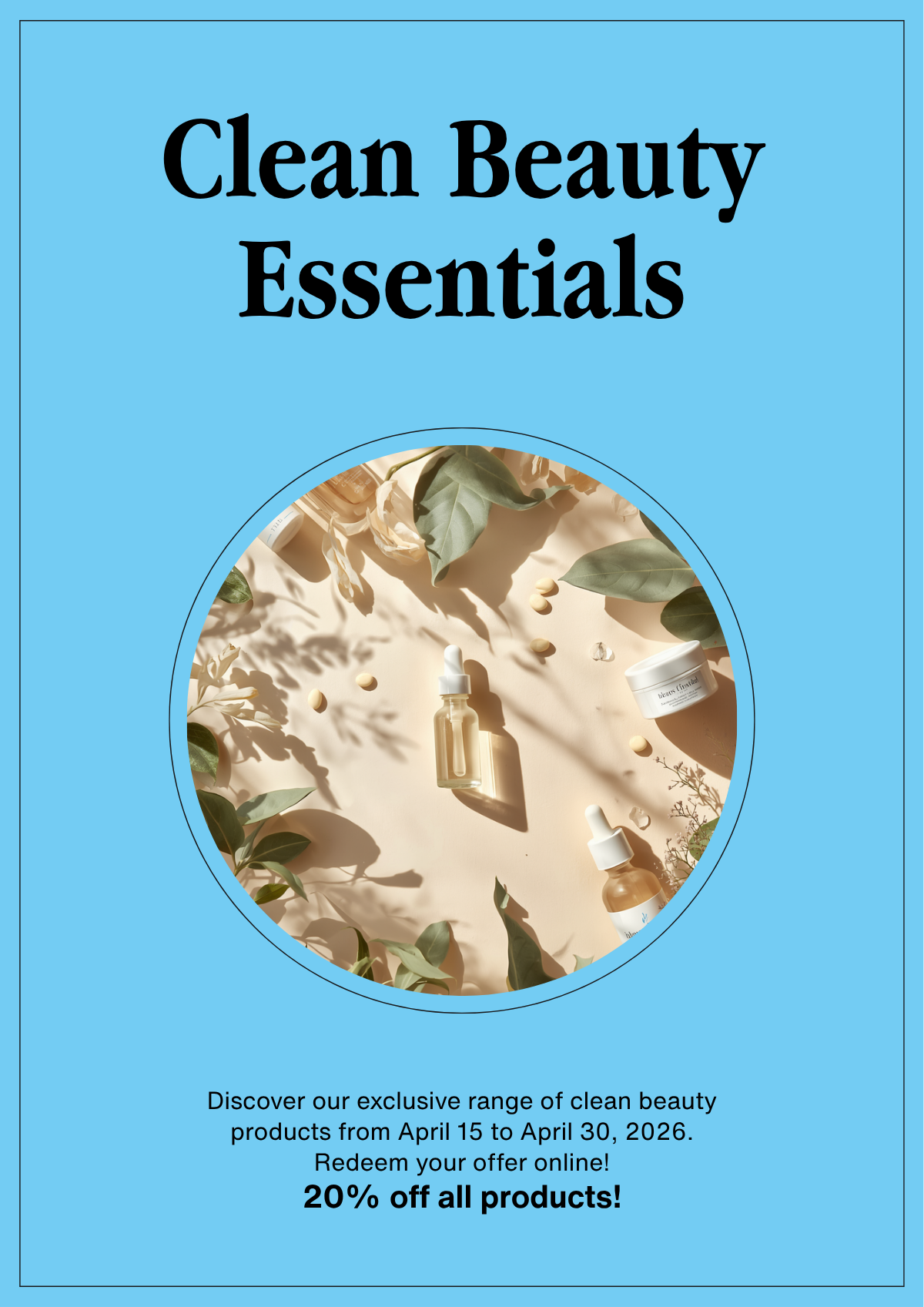
What is clean beauty? The definition finally made clear
Clean beauty refers to cosmetic products formulated without ingredients considered potentially harmful to health or the environment. No suspected endocrine disruptors, no controversial parabens, no aggressive sulfates, no problematic synthetic fragrances.
But here's the problem: there is no universal legal definition of clean beauty. Unlike regulated terms, "clean" remains a marketing concept without legal framework. This void creates gray areas — and opens the door wide to greenwashing.
What is generally agreed upon in the cosmetics sector is the idea of a transparent formulation, with identifiable ingredients, a short and legible list, and a proactive safety approach that goes beyond current legal obligations.
Here's the concrete difference between the two approaches:
| Criterion | Conventional cosmetics | Clean beauty |
|---|---|---|
| Number of ingredients | 20 to 50+ | 5 to 20 generally |
| Formula transparency | Technical jargon, little explanation | Legible list, each ingredient justified |
| Parabens | Frequent as preservatives | Absent or replaced |
| Synthetic fragrances | Very common | Avoided or plant-derived |
| Packaging | Often non-recyclable plastic | Recyclable, refillable or reduced |
| Certifications | Few or no third-party certifications | PETA, COSMOS or verifiable equivalents |
Note: clean beauty does not necessarily mean "100% natural." Some synthetic ingredients are perfectly safe and well-tolerated. The key is transparency and intention — not the dogma of all-natural at any cost.
Why clean beauty is exploding in 2026 — the numbers that are changing the game
This is not a passing trend. Clean beauty responds to a profound and lasting evolution in consumer expectations. Here are some concrete data that speak for themselves:
- 22.1 billion USD: estimated value of the global clean beauty market by 2027, with annual growth of +12% (Grand View Research, 2024)
- 73% of consumers say they want to buy from environmentally friendly brands (Nielsen, 2023)
- 60% of conventional cosmetics reportedly contain at least one ingredient deemed problematic according to the Environmental Working Group (EWG)
- +45% increase in Google searches for "clean beauty" between 2022 and 2025 in France and French-speaking Switzerland
- Generation Z now places brand transparency above brand recognition and price
In French-speaking Switzerland, this trend is confirmed year after year. Consumers want to understand what they put on their skin — and they are absolutely right to demand it.
Brands like Typology or Respire have largely benefited from this wave by placing the transparency of their formulas at the center of their communication. The promise of simplicity and readability resonates strongly, especially with those looking for alternatives to conventional big brands that multiply complex ingredients.
Cosmetic greenwashing: 7 warning signs to spot
The problem with unregulated clean beauty is that any brand can write "clean," "pure," or "natural" on packaging without it meaning anything legally. Here are 7 signs that should immediately alert you:
- Vague and unproven claims: "natural," "pure," "green" without certification or verifiable proof by an independent third party
- Hidden or illegible ingredient list: absent from the website, in tiny print, or deliberately confusing
- Selective "free from": "paraben-free" but with equally controversial alternatives as substitutes
- Deceptive green packaging: leaves, forests, and nature colors on a product whose formula is anything but clean
- Invented certifications: logos that look like recognized official certifications but are not
- Single issue focus: highlighting one positive point to mask an otherwise problematic formula
- Star ingredients in tiny quantities: "with argan oil" when there's only 0.05% in the total formula
The golden rule: if you don't understand the INCI ingredient list of a product, ask the brand to explain it to you. A truly clean brand has nothing to hide.
The clean beauty checklist: 6 criteria for making good choices
Now that you know what to avoid, here's what to actively look for when choosing a cosmetic product:
1. A short and legible ingredient list
Generally, fewer than 15 to 20 ingredients. Each ingredient should have a clear function. If the first 5 are recognizable, that's already excellent.
2. Recognized and verifiable certifications
PETA Vegan & Cruelty-Free, COSMOS Organic, Nature et Progrès. These labels guarantee real audits by independent organizations.
3. Ingredient traceability
Where do they come from? How are they grown or extracted? Clean brands answer these questions without hesitation.
4. Packaging designed for durability
Refillable, recyclable, without superfluous plastic. The choice of packaging reveals a brand's true consistency. Discover why aluminum changes everything in our article on aluminum packaging in cosmetics.
5. Total brand transparency
Does it answer questions? Does it publish and explain its formulas? That's a very good sign.
6. The "read aloud" test
If you can read the first 5 ingredients and recognize them (shea butter, coconut oil, beeswax...), you're looking at something genuinely clean.
| What to look for ✅ | What to avoid ❌ |
|---|---|
| Short list (fewer than 20 ingredients) | Lists of 40+ illegible ingredients |
| Verifiable third-party certifications | In-house logos without real certification |
| Refillable or recyclable packaging | Non-recyclable plastic, over-packaging |
| Brand transparent about its formulas | "Secret" formulas not communicated |
| Identifiable natural ingredients | Poorly identified petrochemical derivatives |
Clean beauty and Earth Day: a coherence that doesn't lie
Earth Day, April 22, is an annual reminder: our daily choices have a real impact. And cosmetics are very much a part of these choices.
In Europe, the beauty sector generates hundreds of millions of plastic packages each year. A tube of mascara. A pot of cream. A bottle of shampoo. Multiply that by tens of millions of consumers and the volume becomes dizzying.
Clean beauty, in its most consistent version, integrates this ecological dimension:
- Formulas without ingredients harmful to aquatic ecosystems: some chemical sunscreens disrupt coral reefs
- Refillable packaging that reduces waste without sacrificing product experience
- Short supply chains that limit the carbon footprint associated with raw material transport
- Ingredients from sustainable agriculture, grown with respect for soils and local biodiversity
To understand how to gradually switch your routine to cleaner alternatives, our guide on transitioning to natural deodorant is an excellent starting point. And to avoid the pitfalls of ingredients like high-dose baking soda, read our article on baking soda in natural deodorants.
The basic. approach: clean beauty handcrafted in Lausanne

At basic., clean beauty is not a marketing argument. It's the starting point for everything we do.
When we created the brand in Lausanne, we asked ourselves one question: why do everyday products need 30, 40, or 50 ingredients? The honest answer: most are there to improve texture or simply to impress on the shelf — not to care for your skin.
Our approach: each ingredient must be there for a specific reason, and we must be able to explain it simply to you. Here's what that looks like in practice:
- Our repairing hand balm is formulated around shea butter: 100% natural origin, ultra-nourishing for dry and damaged hands. No synthetic fragrance, no silicone, no superfluous ingredients. Just what your hands need.
- Our KIIMA refillable deodorant applicator is designed to last for years: never throw away the aluminum casing, just refill the formula. Zero plastic waste with each use cycle.
- All our products are PETA Vegan & Cruelty-Free certified — no animal testing, no animal-derived ingredients in our formulas.
- Each product is handcrafted in Lausanne. Short supply chain, reduced carbon footprint, quality controlled at every step.
We'll never tell you that we're "saving the planet." What we can tell you is that every decision — formulation, packaging, sourcing — is intentional. Designed to minimize our impact and maximize effectiveness for your skin.
To choose the natural deodorant that suits your skin, consult our Swiss natural deodorant guide or our comparison of the best natural deodorants 2026.

FAQ — Your questions about clean beauty
Are clean beauty and natural cosmetics the same thing?
No, these are two distinct concepts. A natural product can contain natural but problematic ingredients — like irritating baking soda in high concentrations. Clean beauty focuses on the safety and transparency of the formula, whether it's natural or partially synthetic. A good synthetic ingredient can definitely be part of a clean formula.
Is clean beauty really effective?
Effectiveness depends on the formula, not the label. Some clean cosmetics are very effective because they concentrate their active ingredients on what truly works. The rule: look at the ingredient list, not just the marketing. A short list with well-dosed active ingredients is better than a long list of good ingredients that are too diluted.
How can I spot greenwashing in cosmetics?
Cosmetic greenwashing involves using ecological or natural arguments for marketing purposes, without the products actually meeting these criteria. The most common signs: green visuals, words like "natural" without verifiable certification, "recyclable" packaging masking a problematic formula. Always read the full INCI list — it never lies.
How do I read an INCI ingredient list?
The INCI list is sorted in descending order of concentration up to 1%. The first 5 ingredients often represent more than 80% of the product. If you recognize the first 3 or 4 ingredients, that's a good indicator. Apps like INCI Beauty or CosmEthics help you decipher unknown labels.
Is clean beauty suitable for sensitive skin?
Generally, yes — especially if the formula avoids synthetic fragrances, irritating alcohols, and controversial preservatives. But even natural ingredients can be irritating. Sensitivity is individual: always do a patch test on your wrist before adopting a new product.
Does clean beauty necessarily cost more?
Not necessarily. Prices have become more democratic in recent years. A refillable deodorant costs less in the long run than a series of disposable plastic deodorants — in addition to producing less waste. Clean beauty can therefore be both economical and ecological.
What's the difference between clean beauty and zero waste?
Clean beauty concerns composition: safe ingredients, formula transparency. Zero waste concerns packaging and life cycle: less waste, refillable, recyclable. The two approaches can perfectly coexist — and the most consistent brands combine both dimensions.
Sources
- Environmental Working Group — EWG Skin Deep Database
- Grand View Research — Clean Beauty Market Size Report 2024
- World Health Organization — Endocrine Disrupting Chemicals
- INCI Decoder — Decoding cosmetic ingredients
- PETA — Vegan and cruelty-free cosmetics guide
Ready to switch to clean beauty every day?
Discover the basic. hand balm — 100% natural origin, handmade in Lausanne — and the refillable KIIMA applicator, for a plastic-free routine. Because every action counts, especially with Earth Day approaching.